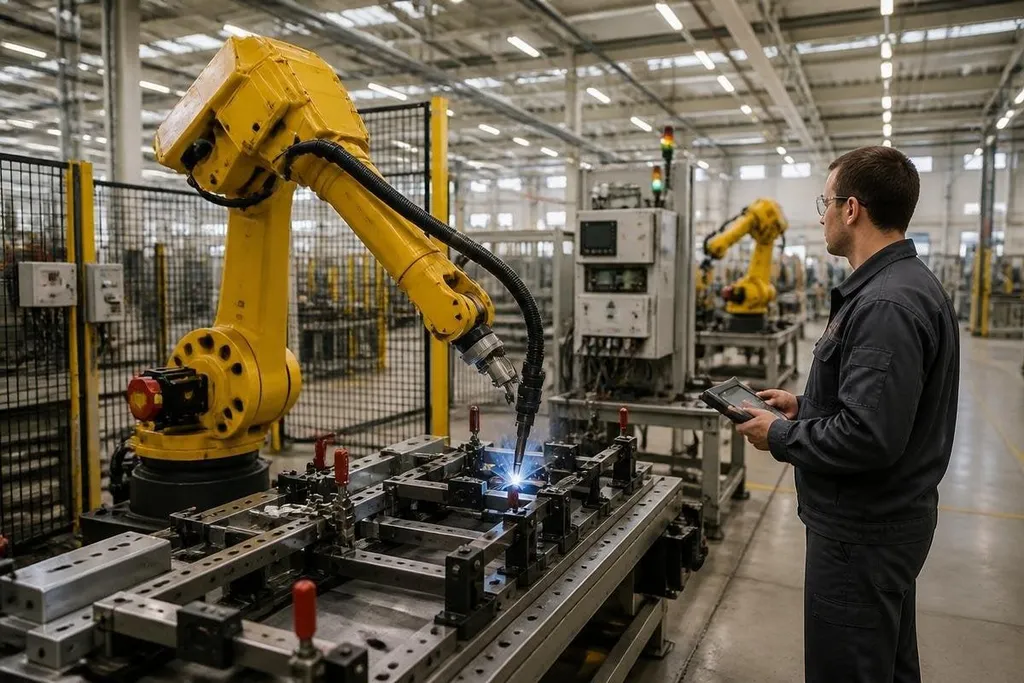
On a production line, a factory robot can weld the same joint, place the same part, or move the same box for hours without changing its motion. The real change comes when that arm joins cameras, sensors, a programmable logic controller, and people in one work cell.
- Robots handle repeat tasks with steady motion.
- Cameras help a cell check part position and surface defects.
- The hard work is choosing a task the robot can repeat safely.
Where robots fit on the factory floor
Most factory robots do a narrow job. A six-axis arm can turn its joints to reach different sides of a part, while a gantry robot moves along fixed rails. A mobile robot carries parts between work areas instead of holding a tool.
The task decides the design. Welding needs a torch and controlled motion. Palletizing needs a gripper that can lift boxes and place them in a set pattern.
Inspection may need a camera, lighting, and software that compares each part with a defined limit. That narrow focus helps the machine repeat a process.
It also sets a boundary: a robot cell built for welding won't pick loose parts from a mixed bin without new hardware and software.
How a robot cell works
The arm is only one part of the system. A controller sends motion commands, sensors check the work area, and a programmable logic controller, or PLC, links the cell to nearby machines.
The PLC can stop a conveyor when a part is missing or pause the arm when a guard door opens.
Vision changes the job again. A camera can find a part's position before the arm moves, so the cell can handle small shifts in placement. That doesn't mean the robot understands the part like a person does. It means the software can measure an image and choose from set actions.
Safety hardware sets another boundary. Fences, light curtains, scanners, and emergency stops keep people outside the arm's reach during automatic motion. Robot cells also follow safety rules such as ISO 10218, which covers industrial robot safety.
For a production manager, this connection matters more than the arm's maximum speed. A fast arm waiting for parts, inspection, or a human handoff won't raise output by itself.
What changes for workers
Automation moves work rather than removing every task. People still load materials, check the cell, fix faults, change tools, and handle parts that the system cannot identify. The job can become less repetitive, but it needs training in controls, sensors, and safe recovery.
The shift also changes how factories plan maintenance. A worn gripper, loose cable, dirty camera lens, or failed sensor can stop the full cell. The fault may sit far from the robot arm, so service teams need records from the whole line.
A robot’s uptime claim means little without the service record behind it. For a production manager, reports on factory robotics from Robot24.com can connect that claim to a named plant, task, and repair history. Those details lead into the harder question of where factory robots still struggle.
Where factory robots still struggle
Robots work best when parts, tools, and steps stay within a known range. Loose materials, changing product shapes, glare on metal, and tight handoffs can make a cell slow or unreliable. A human may fix the issue in seconds because they can see the wider situation; the robot needs a defined sensor input and a programmed response.
The price also goes beyond the arm. A site may need tooling, guarding, cameras, conveyors, software, training, and service support. The right cost check compares the full cell with the labor, downtime, quality loss, and output of the current process.
I’d start with one repeat task that already has clear parts, clear handoffs, and a known failure rate.
A practical decision check
Before buying a robot cell, check these points:
- Repeat steps: Write down the exact motion, part, tool, and handoff.
- Part variation: Measure changes in size, position, finish, and weight.
- Safety space: Map the arm's reach, access doors, scanners, and stop points.
- Full cost: Include the arm, gripper, guarding, cameras, software, training, and service.
- Human work: Assign who loads parts, clears faults, checks quality, and restarts the cell.
- Proof run: Test the task with real parts, normal defects, and the planned production speed.
The investment earns its place when the full cell can repeat a useful task without constant rescue from a person. The next question is specific: which step on your line fails often enough, and stays predictable enough, to hand to a machine?